
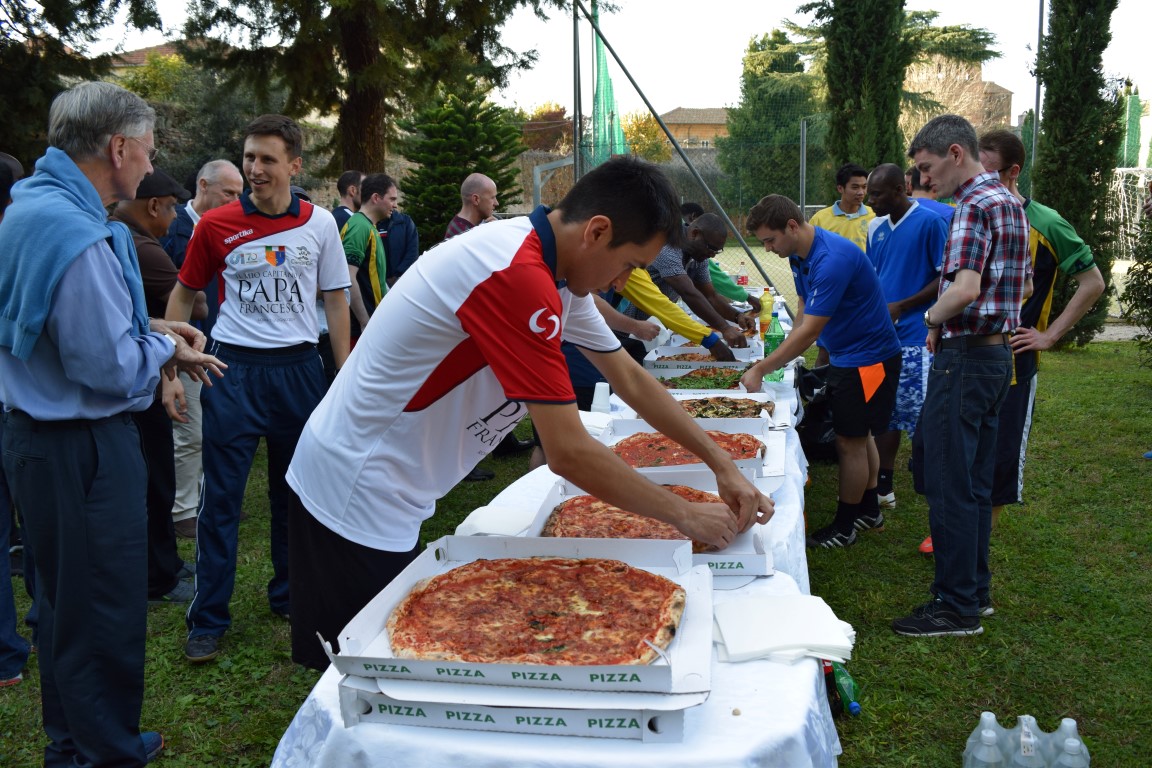
The Annual Fr Ragheed Ganni Memorial Soccer Tournament
The formation programme for seminarians at the Irish College is built on the documents of the Second Vatican Council and the Post-Conciliar documents. In particular, it is anchored on the four dimensions of formation outlined in Pope Saint John Paul II’s 1992 Post-Synodal Apostolic Exhortation, Pastores dabo vobis (PDV) and recently updated in the new Ratio fundamentalis institutionis sacerdotalis, entitled “The Gift of the Priestly Vocation” (GPV). The four dimensions of formation are the Human, Spiritual, Intellectual, and Pastoral.
The Human Dimension
“Human formation, being the foundation of all priestly formation, promotes the integral growth of the person and allows the integration of all its dimensions.” (GPV, 94) Discerning a special vocation to the priesthood, some offer themselves to Christ and his Church in a particular way, and enter the seminary. In so doing, they undertake to follow a programme of formation which, with God’s help, will lead them towards full human maturity, deep spiritual awareness, intellectual growth, and pastoral preparation oriented towards the mission of evangelisation in the third millennium.
Human maturity is a complex reality which cannot be easily or fully defined. One can, however, recognise a mature man. He is a person who, having accepted his personal history, explores and recognises the truth of his identity. He constantly attempts to imbue his human development with Christian values and with the habit of living the Christian virtues. He consistently tries to acquire the capacity to act freely. He is a man who has an obvious emotional self-control, one who enjoys community living because of his willingness to give himself in service of others, and is a person who devotes himself in a steady, consistent and calm way to his vocation and his duties. His conduct is clearly influenced by an informed conscience and he uses his freedom to explore and develop fully his human potential.
“Human maturity and in particular affective maturity requires a clear and strong training in freedom” (PDV, 44). Fostering human development must challenge the seminarian to achieve a convinced and heartfelt obedience to the “truth” of his own being. True freedom asks him to be master of himself and to be ready to open out to others in generous, dedicated service. On his educational journey, the community life of the seminary, the dedicated service of the College staff and their professional collaborators, together with the seminarian’s own family, provide the ambience in which growth and human development take place. The seminary formation programme invests much time and energy in each seminarian and asks of him that he respond to this with complete generosity.
The priest of the third millennium will continue the work of the priests who, in the preceding generations, have animated the life of the Church. During the third millennium the priestly vocation will continue to be the call to live the unique and permanent priesthood of Christ. A renewed vision for this new era is required so that the timeless and age old mission of Christ and his Church may be fulfilled. Tomorrow’s priest will be “the living image” of Christ, the Head and Shepherd (PDV, 43). In his person he must strive for that level of human maturity which Christ reached in his incarnation and reflect this to the people and culture in which he will offer his service.
The Spiritual Dimension
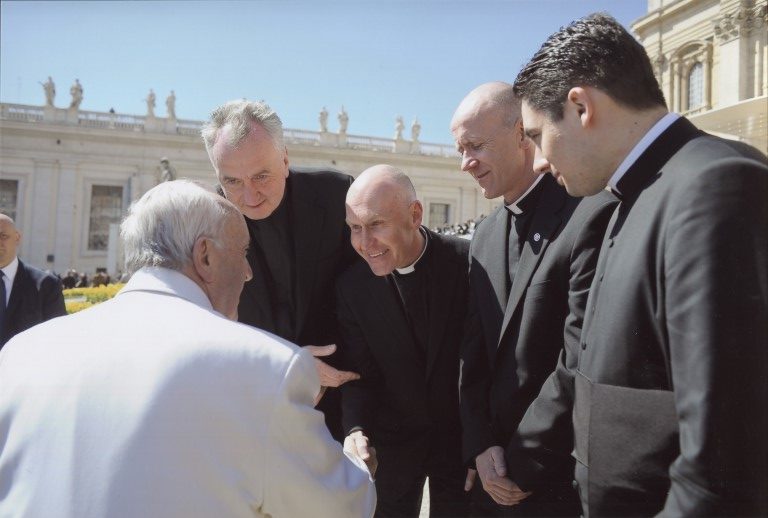
The Rector and newly ordained deacons meet with His Holiness, Pope Francis
“Spiritual formation is directed at nourishing and sustaining communion with God and with our brothers and sisters, in the friendship of Jesus the Good Shepherd, and with an attitude of docility to the Holy Spirit.” (GPV, 101) The spiritual life has as its continuous goal the development of a person’s communion with God and with our brothers and sisters. This faith relationship is based more on an affective experience of divine love than a cognitive understanding of God. In the seminary the student learns to discern the will of God in his life, and grows more generous in embracing that vocation. Personal holiness helps to form a community and in this way the seminary becomes an example of Christian fraternity.
Among the practices that further spiritual development, the life of personal and liturgical prayer is first and foremost. The communal celebration of the Eucharist and the Liturgy of the Hours root the student’s life in Christ and in his Church. A daily time of private meditation is essential to the future priest’s identity with Christ before the Father.
Spiritual Direction facilitates the student’s discernment of God’s will and knowledge of God’s compassion so that he might be free of the obstacles that hinder his faith. In his spiritual director the student finds a trusted anam cara who will accompany him on his inner pilgrimage.
Life in the seminary is characterised by a spirit of reflection. Time for silence and opportunities for solitude form part of the College timetable. Reflection allows the student to be present to the movement of God’s Spirit in his life. The student ought to give time to spiritual reading and acquaint himself with the principles of spiritual theology. In this way he is enabled to understand the meaning of his life and put into practice the faith that he professes.
The Intellectual Dimension
“Intellectual formation is aimed at achieving for seminarians a solid competence in philosophy and theology, along with a more general educational preparation, enough to allow them to proclaim the Gospel message to the people of our own day in a way that is credible and can be understood.” (GPV, 116) A solid philosophical and theological training is essential for all candidates for the priesthood. Seminarians must study and meditate on the Word of God in the light of the tradition and teaching of the Church and learn to express it in a language that can be readily understood in the social and cultural situation of today. To be an effective preacher, teacher and spiritual guide, deacons and priests need to develop a familiarity with the opportunities and challenges posed to Christian faith not only by science and technology but also by contemporary movements in art and literature. All seminarians at the Irish College are assigned to baccalaureate level studies in philosophy or theology, in keeping with their stage of formation. Some students, with the agreement of their Bishop, undertake further specialisation to licentiate or doctoral level. The College programme reserves the central part of every weekday for attendance at lectures, and for personal study and reading. Students are encouraged to make the most of this opportunity by attending their lectures and meeting the requirements of the university for the particular course of study undertaken. Personal reading is an indispensable part of any academic programme. Students have an opportunity to familiarise themselves with the College and university libraries.
Living in Rome provides many opportunities to deepen one’s appreciation of the universality of the Church and to broaden one’s cultural and intellectual horizons. Every effort will be made to facilitate attendance at extra-curricular lectures and courses within and beyond the Irish College. In this context, students are reminded of the importance of attaining a proficiency in the Italian language. Students attend the university and course which have been decided by the Rector and the individual’s Bishop.
The Pastoral Dimension
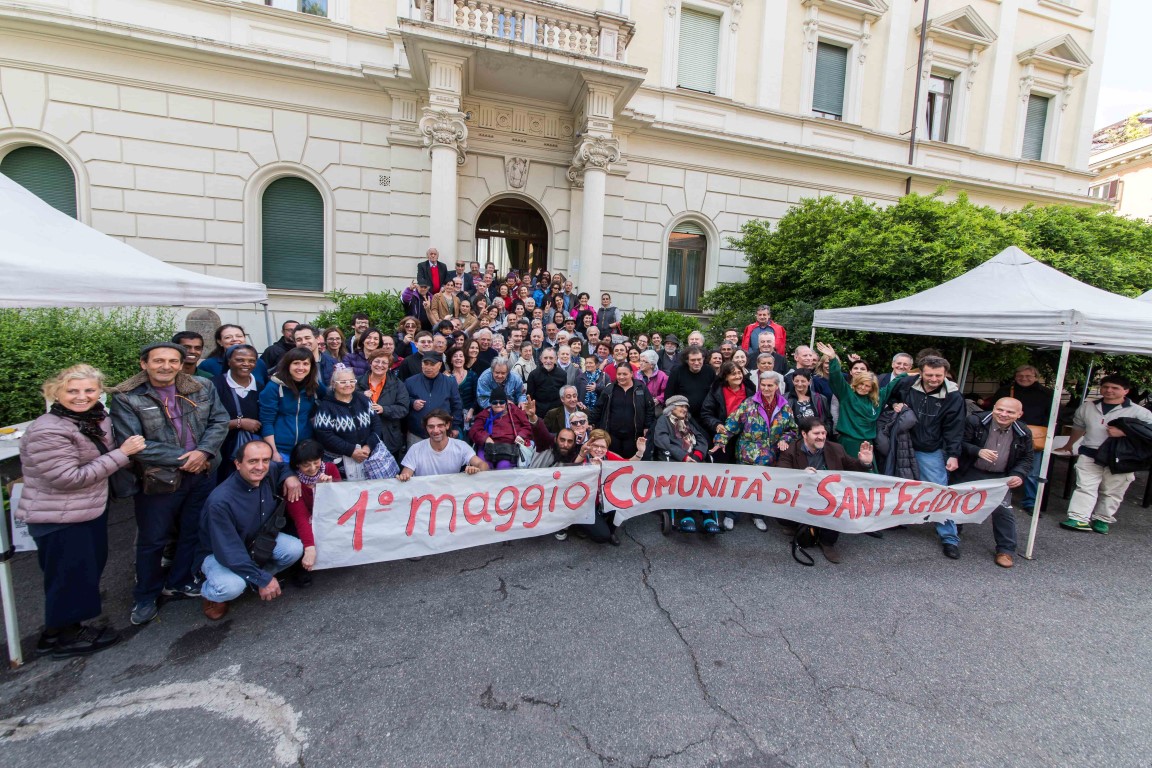
The 1st of May Annual Lunch with the Communitá Sant’Egidio
“Since the Seminary is intended to prepare seminarians to be shepherds in the image of Christ, priestly formation must be permeated by a pastoral spirit. It will make them able to demonstrate that same compassion, generosity, love for all, especially the poor, and zeal for the Kingdom that characterised the public ministry of the Son of God.” (GPV, 119) Pastoral formation ensures that the human, spiritual and intellectual formation of the candidate for priesthood is focused on his future life and ministry as a priest. The pastoral programme for the Irish seminarians takes account of the contemporary context in Ireland and prepares them for ministry in their home dioceses. The programme is designed to offer the student good communication skills, strong and effective leadership qualities, the ability to develop an aptitude for collaborative ministry, as well as to relate well to the culture of the modern world.
Through a programme of pastoral work and reflection, the College attempts to create in each student the compassion of a good shepherd, the ability to assume a conscientious and mature responsibility for the care of souls, and an interior strength and perception which will allow him to evaluate pastoral difficulties and opportunities and establish priorities in his life and work.